Hey there! As a light decoration supplier, I've been getting tons of questions lately about the power consumption of different light decorations. It's a super important topic, especially when you're thinking about decking out your place for holidays or just adding a cozy touch to your home. So, I thought I'd break it down for you all.
Let's start with the most common types of light decorations out there - LED lights. These little guys have become the go - to for a lot of people, and for good reason. LEDs are super energy - efficient. They use way less power compared to traditional incandescent lights. In fact, an LED light can use up to 80% less energy than an incandescent one. That's a huge difference!
Think about it. If you're using a string of incandescent lights for your Christmas tree, it's going to gobble up a lot of electricity. But if you switch to LED lights, you'll not only save on your energy bill but also be doing your part for the environment. For example, a standard 50 - bulb incandescent string light might use around 40 - 50 watts per hour. On the other hand, a 50 - bulb LED string light will use just 2 - 5 watts per hour. That's a massive reduction in power consumption.
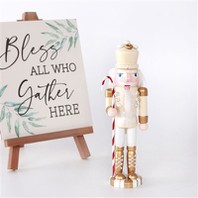
Now, let's talk about some of the specific light decorations we offer. We've got this really cool Christmas Home Tabletop Wooden Candy Gradient Nutcracker. It comes with LED lights embedded in the design. The power consumption of these lights is extremely low. Since it's a tabletop decoration, it doesn't need a lot of power to shine brightly. The LEDs used in this nutcracker are designed to be energy - efficient, so you can leave it on for hours without worrying about a huge spike in your electricity bill.
Another popular item in our collection is the Easter Bunny Wood. This cute wooden bunny is adorned with LED lights that give it a warm and inviting glow. The power usage of the lights on this decoration is minimal. The LEDs are optimized to use just the right amount of energy to create a beautiful effect. You can place it on your Easter table or by the window, and it'll add a lovely touch to your Easter decor without costing you much in terms of electricity.
We also have Wooden Easter Rabbits. These are a set of charming wooden rabbits with LED lights. The power consumption of the lights on these rabbits is in line with other LED - based light decorations. They're small and don't require a lot of energy to light up. Whether you're using them for indoor or outdoor Easter displays, you can be confident that they won't be a drain on your power supply.
When it comes to other types of light decorations, like fiber - optic lights, they also have relatively low power consumption. Fiber - optic lights work by transmitting light through thin strands of fiber. They use a small light source, usually an LED, to generate the light. This means that the overall power usage is quite low. However, the power consumption can vary depending on the size and complexity of the fiber - optic setup.
Some people still prefer traditional incandescent lights for their warm, soft glow. But as I mentioned earlier, they're not very energy - efficient. Incandescent lights work by heating a filament until it glows. This process uses a lot of energy, and most of the energy is wasted as heat rather than light. So, if you're looking to cut down on your energy costs, it might be a good idea to switch to LED or fiber - optic lights.
Now, let's talk about how you can calculate the power consumption of your light decorations. It's actually pretty simple. First, you need to find out the wattage of each light or light set. This information is usually printed on the packaging or on a label attached to the light. Once you know the wattage, you can multiply it by the number of hours you plan to use the lights. For example, if you have a 10 - watt light and you plan to use it for 5 hours a day, the daily power consumption will be 10 watts x 5 hours = 50 watt - hours. To convert this to kilowatt - hours (kWh), which is what your electricity bill is based on, you divide by 1000. So, in this case, it'll be 50 / 1000 = 0.05 kWh.


If you're using multiple light sets, you just need to calculate the power consumption for each set and then add them up. This way, you can get an accurate estimate of how much your light decorations will cost you to run.
As a light decoration supplier, I'm always looking for ways to offer products that are both beautiful and energy - efficient. We understand that our customers want to create a lovely atmosphere in their homes without breaking the bank. That's why we focus on using LED and other energy - saving technologies in our light decorations.
If you're interested in our light decorations and want to learn more about their power consumption or place an order, don't hesitate to reach out. We're here to help you find the perfect light decorations for your needs. Whether it's for a holiday, a special event, or just to add some charm to your everyday life, we've got you covered.
In conclusion, the power consumption of light decorations can vary greatly depending on the type of lights used. LED lights are by far the most energy - efficient option, followed by fiber - optic lights. Traditional incandescent lights, while they have their charm, are not the best choice if you're looking to save on energy. By choosing energy - efficient light decorations, you can enjoy a beautiful and festive atmosphere without worrying about high electricity bills.
References:
- General knowledge about electrical power consumption and light technologies.
- Product specifications of the light decorations offered by the supplier.